Crypto sold off again today, extending a drawdown that’s now lasted more than a month. Bitcoin briefly pushed back below $84,000 before rebounding by pixel time, but the structure of the move hasn’t changed: another billion dollars of leveraged positions were liquidated, and that figure likely understates the true scale given how selectively exchanges report liquidation data.
The more revealing stress is in the vehicles built to make crypto look institutional. ETF inflows remain thin, retail proxies are posting outsized losses, and Strategy Inc. is now publicly defending its balance sheet. A new $1.4 billion reserve gives the company runway for dividend and interest payments, yet it also highlights the fears around the sustainability of the entire business model as falling Bitcoin prices directly threaten corporate obligations.
As Michael Saylor’s firm takes hits, the products that rode its ascent are feeling it even more. Single-stock ETFs tied to Strategy, marketed as high-octane ways to express Bitcoin conviction, have become some of the worst performers in the entire ETF universe. What worked in the upcycle leveraged exposure to a stock levered to Bitcoin is now compounding downside. The structure that amplified Saylor’s strategy on the way up is magnifying every wobble on the way down. Crypto routs are routine. What’s different this time is how much of the pressure is being transmitted through the very wrappers that were meant to domesticate the asset class.
Stocks aren’t immune to the crypto pain, yet the damage will likely remain contained.
The two asset classes retain a strong technical link, with Bitcoin’s correlation to equity indexes still pretty tight. Yet that has begun to loosen as it’s becoming clearer that the renewed crypto slump isn’t signalling a broader risk-off turn rather, it’s just an extension of a crypto-specific unwind.
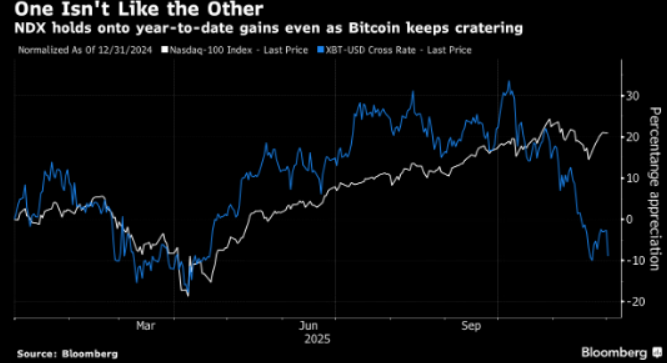
For more evidence of a limited read-through to equities, look no further than the past few weeks. Benchmark stock indexes largely have held year-to-date gains even as Bitcoin slumped into the red for the year. Sure, there have been bumps along the way, the selloff nearly turned into a correction for the Nasdaq 100 at one point but most of those losses have since been recouped.
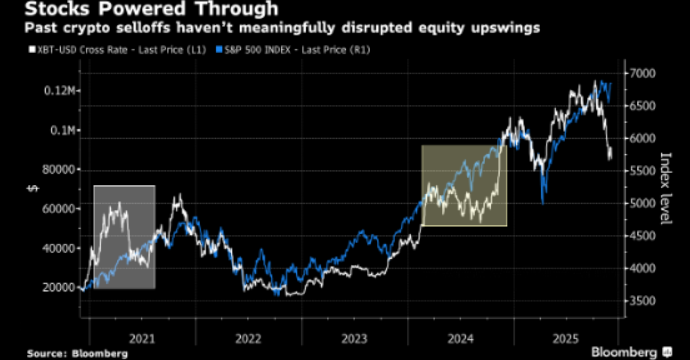
Past pullbacks in crypto have also failed to dent stocks too much. In the past five years, except during major risk events that took all risk assets down (like the 2022 Fed tightening or this year’s tariff shock), stocks have often pushed higher despite steep selloffs in crypto.
Granted, with some US companies like Strategy heavily invested in Bitcoin (of the company’s $73.62b total assets, $73.21b are digital assets), a deeper slump creates more vulnerability. Yet those names aren’t too systemic to the broader market: Strategy accounts for only 0.2% weight in the Nasdaq 100; Coinbase Global is 0.1% of the S&P 500. And even when risk aversion eventually spills over, equities have a floor that crypto lacks: real earnings.